
Lathe Chucks for Mini Lathes
We have lots of options for lathe chucks for your 7x10, 7x12, 7x14, or 7x16 mini lathe.
Types of Lathe Chucks
The most common types of lathe chucks are 3-jaw self-centering and 4-jaw independent. These two are so common that they are usually just called 3-jaw and 4-jaw. The "self-centering" and "independent" are understood. A well-equipped lathe has both a 3-jaw and a 4-jaw chuck. Don’t try to always use one or the other.
Other lathe chucks include 4-jaw self-centering and 6-jaw self-centering. These are relatively specialized and much less common than the normal 3-jaw and 4-jaw chucks.
Sizes of Lathe Chucks
Mini lathes can use 3", 4" and 5" lathe chucks. Most mini lathes are shipped with a 3" 3-jaw chuck. One restriction of a 3" 3-jaw chuck is that the center hole in the chuck is smaller than the hole through the spindle. You can run material up to 5/8" in diameter through a 3" 3-jaw chuck, while the mini lathe spindle will accommodate 3/4" diameter material. Some lathes including the LittleMachineShop.com HiTorque Mini Lathes ship with a 4" 3-jaw chuck. A 4” chuck is generally considered the optimal size for a mini lathe. While you can use a 5"chuck on a mini lathe, it is a bit too big for a 7" swing lathe as it’s often difficult to use full aperture of the jaws without conflicting with the bed. It’s also a lot of weight on a small machine, so don't get a 5" chuck unless you have an application that demands it.
Here is a chart that provides lathe chuck capacities and mounting dimensions.
Spindle Flange
When considering the acquisition of a new lathe chuck, there’s one specification that you need to know: the diameter of the flange on your lathe’s spindle. This dimension is easy to figure out. If the lathe chuck that came on your lathe is about 3" in diameter, your spindle has an 80 mm flange. If the lathe chuck that came on your lathe is about 4" in diameter, your spindle has a 100 mm flange. The overwhelming majority of mini lathes have been shipped with a 3" lathe chuck.
Not surprisingly, the chucks commonly called 3" are actually 80 mm (3.15") in diameter. The chucks called 4" are actually 100 mm (3.94") in diameter. This reflects a common practice of items manufactured with metric specifications but sold in markets where products are sold in units of measure of an inch.
If you need to mount your chuck to a spindle size that is different (e.g. a 4” chuck on a 3” spindle) then you will need a chuck adapter
More on Lathe Chuck Adapters HERE
3-Jaw Lathe Chucks
3-Jaw Self Centering Lathe Chucks
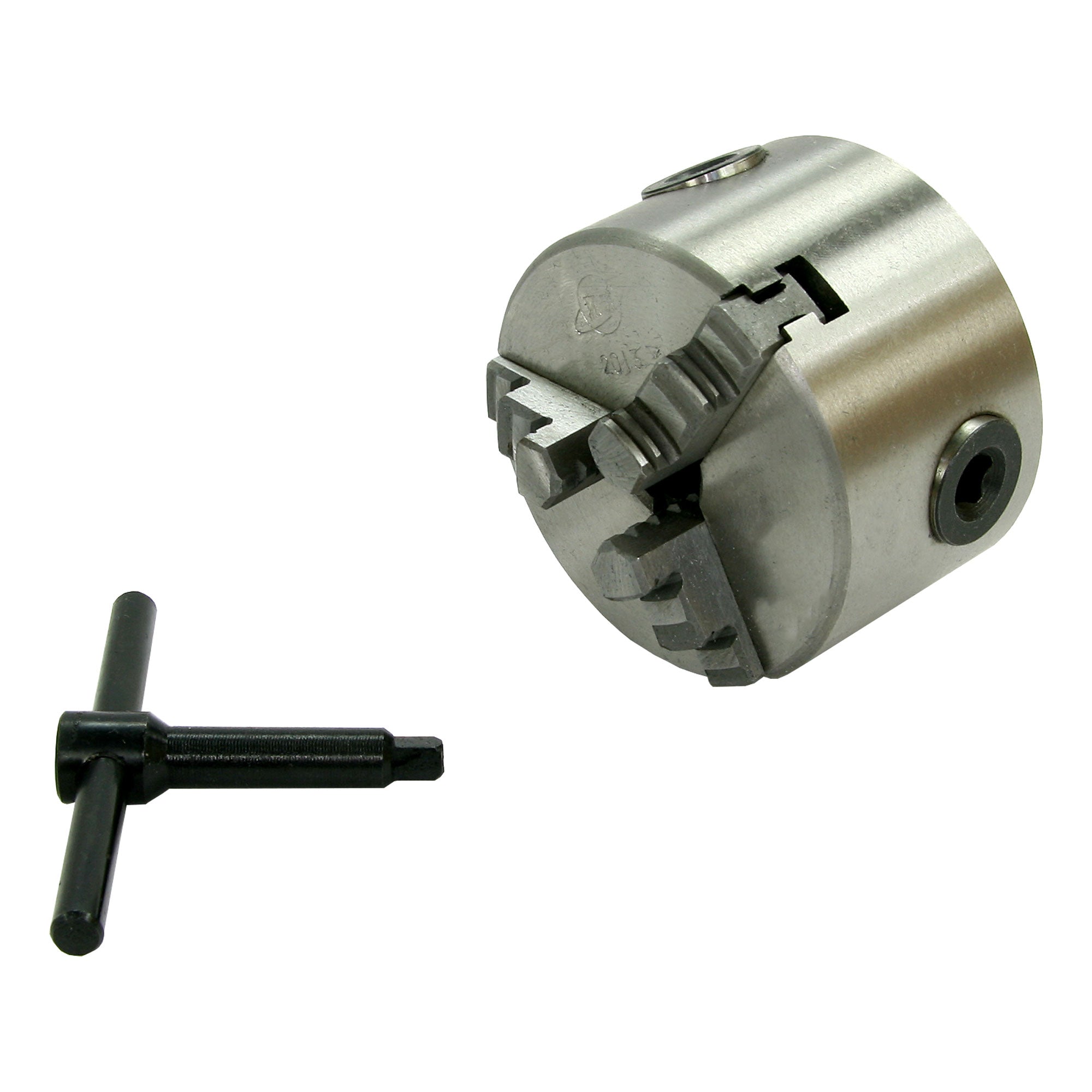
Most metalworking mini lathes are shipped with a 3-jaw self-centering lathe chuck installed. These chucks are used for at least 80% of all mini lathe work.
Self-centering lathe chucks rely on a scroll to move the jaws in synchrony. The teeth on the back of each jaw are placed differently so that they all align when placed in their proper position in the scroll. Because this mechanism is relatively complicated to make, self-centering chucks usually have 0.003"-0.004" (0.08-0.10mm) of runout.
The self-centering jaw design means that the jaws must be installed in the lathe chuck in a specific order for them to align. You will find a number in the groove in the side of each jaw that identifies its position in the set. Place jaw number one in the groove with the serial number in it. Then place the other jaws into their respective slots going in a counterclockwise direction.
Because of the curve in the teeth on the back of the jaws, self-centering chucks usually come with two sets of jaws. The "normal" set is called the inside jaws, because the stepped side is designed to fit inside of hollow work pieces and hold by an outward force. In many cases, however, these jaws are used to clamp on the outside of smaller objects using the long straight side. The second set of jaws is called the outside jaws because the stepped side of these jaws is designed to clamp on the outside of larger objects.
4-Jaw Lathe Chucks
4-Jaw Independent Lathe Chucks
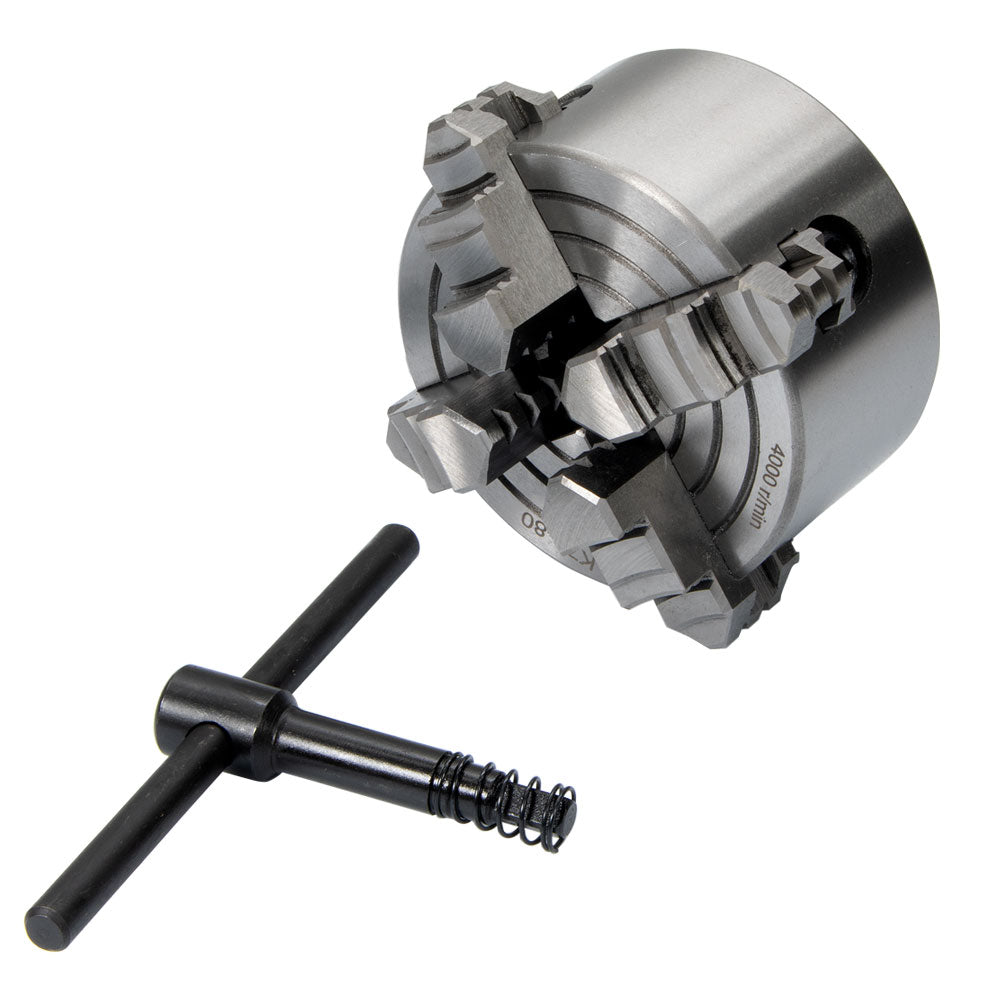
4-Jaw independent lathe chucks have many capabilities, but they take longer to set up. These chucks can center work accurately, they can hold square, rectangular, and odd-shaped workpieces, and they can be set off center.
Each jaw in a 4-Jaw independent lathe chucks can be adjusted independently. They each have their own adjusting screw. Because of this construction, the jaws are reversible, so only one set of jaws is needed.
While a lot of folks will tell you that it’s hard to adjust a 4-jaw chuck using trial and error, there is a simple process that makes it a quick operation. Here’s how to center work in a 4-jaw independent lathe chuck. Centering a 4-jaw independent chuck is still not as quick as putting a workpiece in a 3-jaw chuck, so you do not want to leave your 4-jaw chuck on the lathe all the time. Spend the two minutes that it takes to change chucks.
Other Lathe Chucks
4-Jaw Self Centering Lathe Chucks
4-Jaw self-centering lathe chucks are a bit of a strange beast. They are really only good for holding square stock. And they have the centering limitations of all scroll chucks. Don’t get one of these because they are quick to mount a workpiece. They have none of the advantages of a 4-jaw independent chuck.
6-Jaw Self-Centering Lathe Chucks
6-Jaw self-centering lathe chucks are made to hold tubing. The six jaws give more even pressure around the circumference to help prevent distortion. Because of the specialized application there are no outside jaws furnished. The one set of jaws furnished can hold any size of tubing in the rated range.