


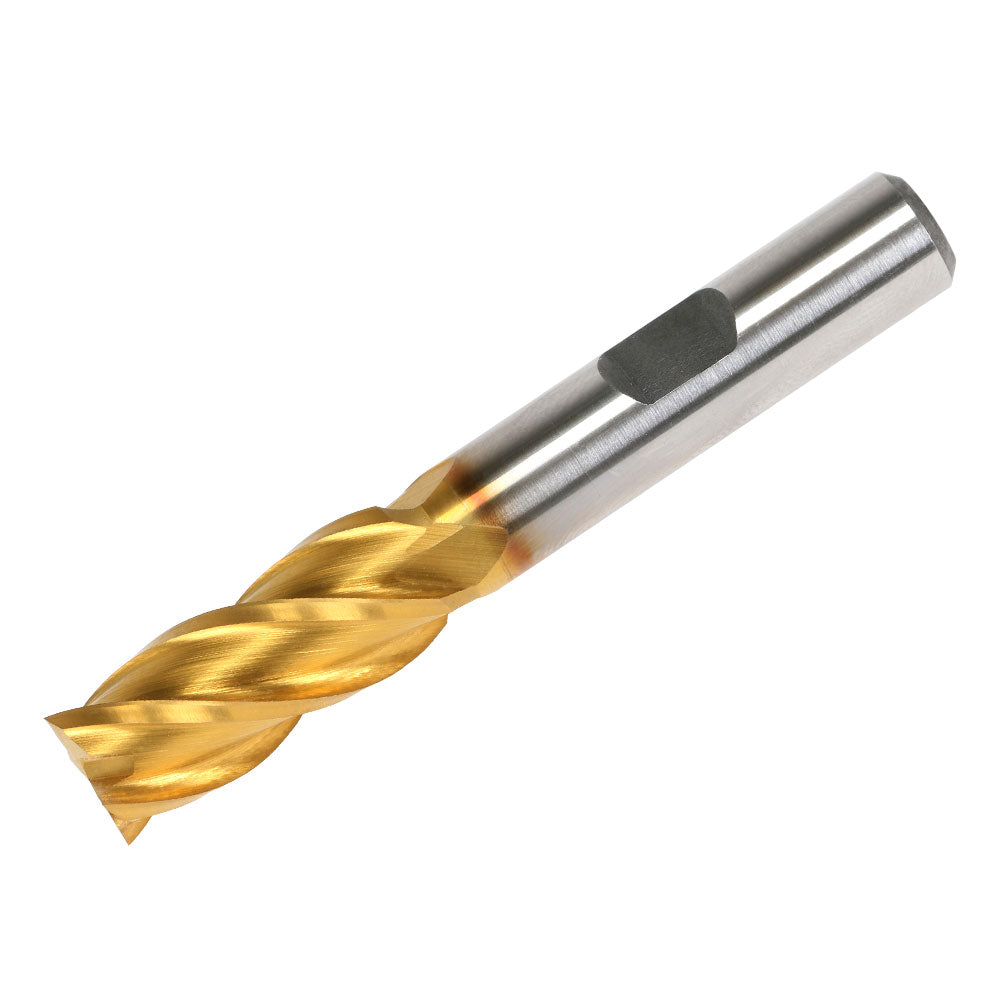
End Mills, 4 Flute, M42 Cobalt, Coated, Individual Sizes
End Mills, 4 Flute, M42 Cobalt, Coated, Individual Sizes
Made in United States of America (USA)

Low stock
SKU:4896Shelf Location: (D05 - 02)
Key Features
Key Features
WARNING: This product can expose you to chemicals known to the State of California to cause cancer and birth defects or other reproductive harm. For more information go to www.P65Warnings.ca.gov.
View full details


Description
These are high quality, American made, cobalt end mills for general milling operations including slots, grooves and other similar features.
They are ground from solid M42 8% cobalt steel. The cutting areas are either Titanium Nitride (TiN) or Titanium CarboNitride (TiCN) coated.
These CNC qualified end mills feature a spiral flute design for a faster and smoother cutting action.
Flute length and overall length vary, see Specifications.
Chris' Tips
Conventional wisdom is that 2-flute end mills are used on aluminum, while 4-flute end mills are used on steel and brass.
2-flute end mills are used on aluminum because aluminum is easy to machine and you can take big cuts. Two-flute end mills provide a lot of room between the flutes for the big chips produced when making heavy cuts.
4-flute end mills can produce a slightly better finish at the same cutting speeds because there are twice as many cutting edges, each taking off half as much material. But again, if you are not trying to maximize production, you can simply slow the feed rate with a 2-flute end mill for the same effect.
End mills are also classed as "center cutting" or "non center cutting".
With a center cutting end mill, you can plunge the end mill into the work as you would a drill. This is important if you are cutting a slot that does not extend to the edge of the part.
Non - center - cutting end mills are ideal for operations where you're only cutting along the sides of the workpiece. Because of this "design" they can often provide a better surface finish on the sides of the cut.
Center cutting end mills are easy to identify. If the flutes meet in the middle of the end of the end mill, it is a center cutting end mill. In some cases, one of the flutes will be longer, reaching right to the center. If the flutes stop short of the center, leaving a space with no flutes in the center, it is a non-center cutting end mill.
